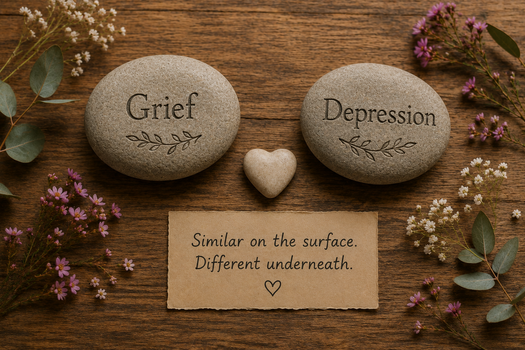
 Grief vs depression: how do you tell the difference?
At some point, almost everyone who is navigating loss asks the same question. Is this normal sadness, or is something else going on? It is one of the most common questions I hear from people I work with, and one I asked myself when navigating grief. So, what are the differences? The two experiences can look remarkably similar from the outside, and from the inside. And that overlap can make it genuinely difficult to know what you are dealing with. This blog is not about giving you a diagnosis. It is about helping you understand the differences, recognise when they overlap, and feel more confident about reaching out for support. What is grief? Grief is a natural response to loss. While we most often associate it with death, grief can occur after many different kinds of loss, including the end of a relationship, a significant health diagnosis, job loss, a move, changes to identity or life direction, fertility challenges, or the loss of a dream. Grief is not a disorder. It is a deeply human response to losing something or someone that mattered. It can be painful, disorienting, and exhausting. But it is also a testament to the depth of the connection that existed. The term bereavement is specifically used when a person is grieving following the death of someone important to them, though grief itself is broader than death alone. What is depression? Depression is more than feeling sad, and it is more than having a bad week or a difficult month. It is a mental health condition that affects how a person thinks, feels, and functions, often persistently and across multiple areas of life. Common signs of depression include persistent low mood, loss of interest or pleasure in activities that were once enjoyable, feelings of hopelessness or worthlessness, difficulty concentrating, changes in sleep or appetite, low energy, and in more serious presentations, thoughts of not wanting to be here. Depression can occur independently of any identifiable loss or life event, though it can also be triggered or worsened by difficult life circumstances. How are grief and depression similar? This is where things can become confusing. Grief and depression share many overlapping signs, which is precisely why distinguishing between them can be so difficult. Both can involve sadness, tearfulness, fatigue, social withdrawal, difficulty concentrating, changes in sleep and appetite, and a reduced interest in everyday activities. Someone who is grieving can look, from the outside, as though they are depressed. And someone who is depressed may appear, to themselves and others, to be going through grief. The experiences genuinely do overlap, and importantly, they can also occur at the same time. How are grief and depression different? One of the most useful distinctions is where a person's emotional experience is centred. With grief, the pain is typically connected to a specific loss. The sadness, longing, and distress are tied to the person, relationship, or situation that has been lost. Grief tends to come in waves, with moments of intense pain alongside moments of connection, warmth, or even gratitude. People who are grieving often retain a sense of love and connection to what was lost. They can still access positive memories, and can still experience joy, even if only briefly, without feeling that it negates the grief. With depression, the low mood tends to be more pervasive and persistent. It is not anchored to a specific loss. It extends across many areas of life, affecting how a person feels about themselves, their future, and the world. Positive experiences may feel hollow. The future can feel hopeless, regardless of external circumstances. What is prolonged grief disorder? For most people, grief gradually becomes less acute over time, even while the loss remains significant. For some people, however, grief remains intensely disabling for an extended period, sometimes more than a year after the loss, in ways that significantly affect daily functioning. This is sometimes referred to as prolonged grief disorder or complicated grief. It may involve persistent longing for the person who was lost, difficulty accepting the reality of the loss, bitterness or anger about the death, a sense that life is meaningless without the person, and an inability to trust others or engage with life. This is not a sign of weakness or of grieving incorrectly. It is a recognised experience that benefits from specialised support. Can grief turn into depression? Yes, it can. For many people, grief gradually eases as time passes. For others, a significant loss can trigger or contribute to depression developing alongside, or following, the grief. This does not mean the person grieved in the wrong way. It simply means that the impact of the loss was significant enough to affect their mental health more broadly, and that additional support is warranted. Can grief and depression occur together? Absolutely. Having one does not protect you from the other. Someone may already be living with depression when a significant loss occurs, making the grief harder to navigate. Or grief may, over time, develop into depression. Or both may be present simultaneously, each reinforcing the other. This is one of the reasons that professional support, particularly from someone with experience in both grief and mental health, can be so valuable. Untangling what is happening, and finding an approach that addresses the full picture, takes more than just time. Is my grief normal? This is one of the questions I am asked most often in my counselling practice. And the answer, almost always, is yes, even when the grief looks nothing like what the person expected. Grief does not follow a universal timeline. There is no correct sequence of emotions, no point at which you should be 'over it', no right amount of sadness or crying or carrying on. Your experience may look very different from someone else's response to a similar loss, and that does not make it wrong. When should I seek support? There is no threshold you need to reach before seeking support. You do not need to be in crisis. You do not need to prove that things are serious enough. Support may be helpful if you feel stuck or unable to move through the loss, if grief or low mood is significantly affecting your daily functioning, relationships, or sense of self, or if you are unsure whether what you are experiencing is grief, depression, or something in between. Grief-informed counselling draws on specific approaches to loss, bereavement, and adjustment. If you are on the Southern Gold Coast or anywhere in Australia, support is available both in person and online through Clarity Collective. Moving forward The question 'Am I grieving or am I depressed?' does not always have a clean answer. Sometimes it is clearly one or the other. Often, the experiences overlap in ways that are difficult to separate. Whatever you are experiencing, you do not have to navigate it alone. Both grief and depression are real, both have significant impact, and both deserve support. Frequently asked questions: How do I know if I am grieving or depressed? The main distinction is that grief tends to be connected to a specific loss and comes in waves, with moments of connection and even joy in between. Depression tends to be more pervasive and persistent, affecting how you feel about yourself, your future, and the world more broadly. The two can also occur at the same time. Can grief turn into depression? Yes. For some people, the impact of a significant loss can trigger depression alongside, or following, the grief. This is not a sign of grieving incorrectly. It simply means the loss has affected mental health more broadly, and that additional support is warranted. Is it normal to feel hopeless after a loss? A degree of hopelessness can be part of grief, particularly in the early period. However, if hopelessness is persistent, pervasive, and extending beyond the loss itself, it may be a sign that depression has developed alongside the grief. When should I seek professional support for grief? You do not need to be in crisis before reaching out. Support is worth considering if grief is affecting your daily functioning, if you feel stuck, if you are unsure whether what you are carrying is grief or depression, or if you would simply like a dedicated space to process what has happened. If you are unsure whether what you are carrying is grief, depression, or both, that uncertainty is worth exploring with someone who can help you make sense of it. You do not need to have it figured out before reaching out. If you liked this article, you might also enjoy reading:
About Clarity Collective I'm Femke Romeijn, a social worker, counsellor, educator, and AASW Accredited Supervisor based on the Southern Gold Coast. Through Clarity Collective, I provide counselling, clinical supervision, and education both locally and online across Australia. I support individuals navigating grief and loss, ADHD, trauma, burnout, and life transitions, while also creating space for students, social workers, helping professionals, and organisations to reflect, learn, and grow. You can learn more about me, explore the counselling and supervision services I offer, or contact me if you would like to connect. Comments are closed.
|
CLarity Collective BlogI have always enjoyed breaking down complex topics and making them easier to understand. ArchivesCategories |
 RSS Feed